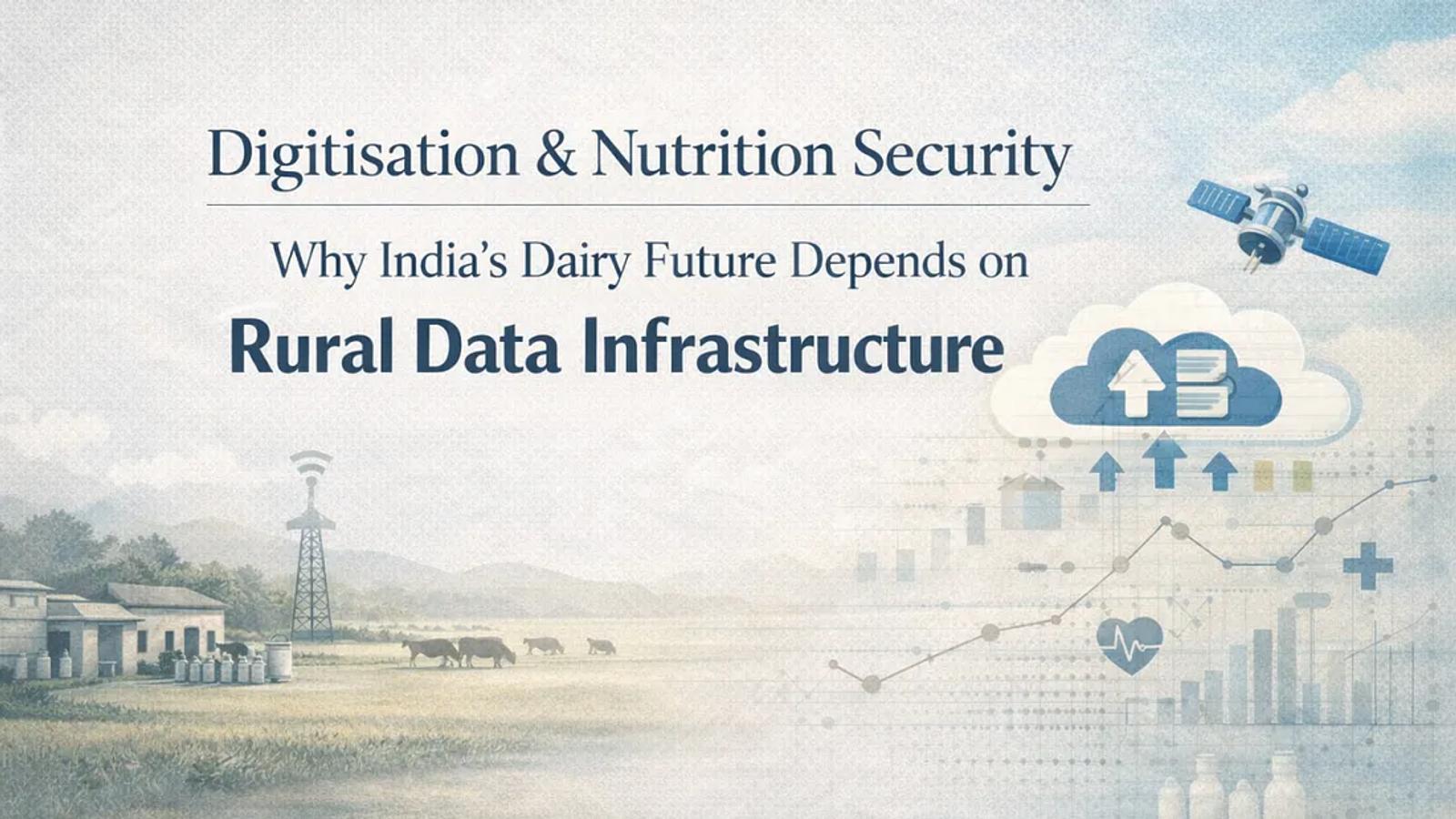
Digitisation & Nutrition Security: Why India’s Dairy Future Depends on Rural Data Infrastructure
When nutrition security is discussed in India, the focus usually remains on cereals, pulses, and public food distribution systems. Dairy is acknowledged, but rarely examined with the depth it deserves.
Yet milk plays a distinct and critical role in Indian nutrition. It is among the most accessible sources of high-quality protein, calcium, and essential micronutrients, particularly for children and women in rural households. For many families, regular access to milk forms the backbone of daily nutrition.
Despite this importance, the system that produces this nutrition is far more fragile than it appears. Milk availability and quality depend heavily on cattle health, everyday farm-level decisions, and the ability to identify and respond to problems early.
The reality is straightforward.
India’s dairy nutrition security is only as strong as the weakest data link in its villages.
1.Nutrition security begins with cattle health
Milk quantity, quality, and affordability are all directly linked to cattle health.
When cattle fall ill, the impact is not limited to reduced milk volume. Illness also affects milk composition, shelf life, and acceptance in organised supply chains. In many cases, milk is discarded entirely during treatment periods.
One of the most studied examples is mastitis.
A large India-focused meta-analysis covering studies from 1967 to 2019 reports:
- Approximately 45 percent prevalence of subclinical mastitis
- Around 18 percent prevalence of clinical mastitis
Subclinical mastitis is particularly damaging because it shows no visible symptoms but significantly reduces milk yield and quality.
Source: National Institute of Veterinary Epidemiology and Disease Informatics (NIVEDI)
https://nivedi.res.in/Nadres_v2/pdf/Meta-Analysis/m3.pdf
This is not just an animal health issue.
When milk quality drops or supply becomes inconsistent, household nutrition suffers first, followed by farmer income and local availability.
Cattle health, therefore, is not a side issue in nutrition security. It is a foundational one.
2. India produces the most milk, but efficiency tells a different story
India is the world’s largest milk producer, contributing over 22 percent of global milk production.
Source: FAO
https://www.fao.org/dairy-production-products/production/milk-production/
However, national production volume masks persistent inefficiencies at the village level.
Across multiple studies, recurring challenges include:
- High disease prevalence
- Inconsistent milk yield across seasons
- Quality loss due to delayed disease detection
- Uneven access to veterinary and extension services
The gap is not about effort. It is about visibility.
Without early signals, health issues escalate quietly. By the time symptoms are obvious, losses are already locked in.
Nutrition security is not only about how much milk a country produces. It is about whether milk is reliably available, safe, and nutritionally consistent at the household level.
3. Where rural dairy systems break down
Most villages still rely on:
- Memory-based health tracking
- Paper registers
- Delayed reporting
- Reactive veterinary visits
This creates three structural blind spots.
First, disease patterns remain invisible.
Without aggregated data, recurring problems go unnoticed until milk supply drops.
Second, interventions cannot be measured.
NGOs, cooperatives, and CSR programs struggle to answer what actually improved outcomes and where.
Third, policy decisions lack ground-level evidence.
Without village-level health and yield data, planning remains generic and top-down.
This is not a lack of technology.
It is a lack of data flow.
4. What digitisation actually changes
Digitisation does not replace farmers’ experience. It strengthens it.
By converting daily observations into structured records, digitisation turns individual inputs into collective intelligence.
Research in precision livestock farming shows that:
- Behavioural changes often precede visible disease
- Continuous data capture improves timing of intervention
- Predictive models reduce severity and recurrence of illness
Source: MDPI, Intelligent Systemisation in Livestock Farming
https://www.mdpi.com/2624-7402/6/2/84
When rural dairy systems adopt basic data infrastructure:
- Health issues are detected earlier
- Disease duration reduces
- Milk yield becomes more stable
- Supply predictability improves
This approach is already standard in advanced dairy economies. The question is not whether it works, but how effectively it can be adapted for smallholder systems.
5. Nutrition security is a systems outcome
It is easy to place responsibility on farmers alone. In reality, nutrition security depends on systems working together.
Farmers need simple, fast data entry.
Veterinarians need health histories and trends.
NGOs need measurable impact.
Cooperatives need quality assurance signals.
Policymakers need reliable, real-time insights.
This is where platforms like Nitara focus their role, by enabling structured cattle-level data capture and herd-level visibility without adding complexity for farmers.
The objective is not digitisation for its own sake.
It is decision-making that is timely, evidence-based, and scalable.
6. Why this matters for India’s future
India’s nutrition challenge is not limited to urban malnutrition. Rural vulnerability remains equally critical.
Milk contributes directly to child growth, maternal nutrition, and protein intake in low-income households.
If dairy systems remain reactive and undocumented:
- Nutrition outcomes stay fragile
- Intervention costs rise
- Farmer confidence erodes
Digitisation offers a rare alignment of outcomes. Healthier cattle support steadier farmer income, more consistent milk supply, and measurable results for development programs.
Nutrition security becomes planned, not accidental.
India does not lack dairy animals.
India does not lack farmers.
India does not lack demand.
What many villages still lack is data continuity.
Rural data infrastructure is not an add-on to dairy farming. It is the backbone of a system that can deliver nutrition reliably, sustainably, and at scale.
When cattle health becomes predictable, milk becomes reliable, and nutrition becomes secure.
That is where India’s dairy future truly depends