The Next Decade of Indian Dairy: AI, Data & the Rise of Farmer-Centric Tech Platforms
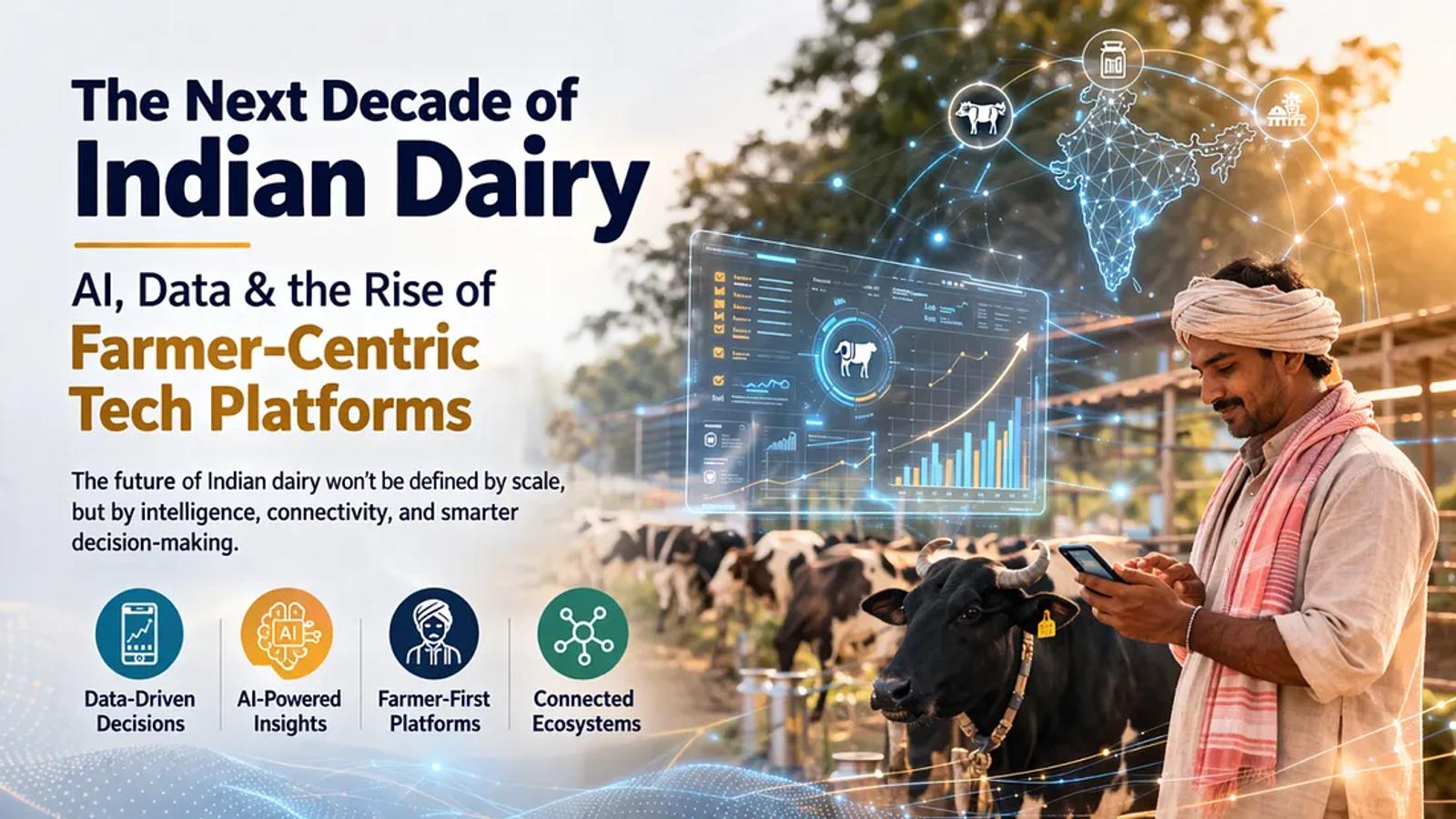
India’s dairy sector has always been defined by scale. Millions of farmers, hundreds of millions of cattle, and the position of being the world’s largest milk producer have shaped its identity for decades. But over the next decade, scale alone will no longer be the defining advantage. The future of Indian dairy will be shaped by intelligence.
1. From Volume to Intelligence
For years, dairy growth in India has been driven by expansion. More cattle, wider procurement networks, and increased milk collection have been the primary drivers of progress. This model worked when the goal was availability. However, the next phase demands consistency, predictability, and efficiency.
This shift requires moving from experience-based decisions to evidence-based systems, where data plays a central role in guiding outcomes. India already contributes a significant share to global milk production, highlighting the scale of the ecosystem. The next step is to make that scale more efficient and reliable.
2. The Rise of Data-Led Dairy Systems
A significant portion of dairy decision-making still relies on observation and memory. While experience is valuable, it often lacks continuity. Without structured data, patterns remain hidden and inefficiencies go unnoticed.
With consistent data capture, performance becomes measurable and trends become visible. Over time, this enables more reliable and repeatable decision-making. The real transformation in dairy will not come from adding more inputs, but from improving the quality of everyday decisions.
3. AI as a Decision Support Layer
There is a growing perception that AI will replace human roles in agriculture. In reality, its role is to support better decisions.
AI helps identify patterns, detect early signals, and recommend actions based on historical data. It brings clarity to complex situations, allowing farmers and field teams to act with greater confidence.
AI does not replace farmers. It strengthens their decision-making. Instead of relying only on intuition, decisions become more informed and contextual.
4. The Shift Toward Farmer-Centric Platforms
Earlier digital systems in dairy were primarily designed for reporting and monitoring at the organizational level. The next generation is being designed for farmers.
These platforms prioritise simplicity, speed, and usability. Adoption depends on relevance. If a system fits into daily routines without adding friction, it gets used. If it doesn’t, it gets ignored.
The success of any technology in rural ecosystems depends less on features and more on how easily it integrates into everyday work.
5. Connected Ecosystems Will Define Scale
The future of dairy lies in connected ecosystems rather than isolated tools. In a connected system, data flows seamlessly across stakeholders.
Farmers capture data, veterinarians access health histories, technicians track breeding cycles, and organizations monitor herd performance. This interconnected flow reduces duplication, improves coordination, and enhances response time.
As visibility improves, managing scale becomes more structured and less chaotic.
6. From Reactive to Predictive Dairy
Traditionally, dairy management has been reactive. Issues are addressed after they become visible. Breeding is managed after delays occur, and productivity challenges are handled after losses are already visible.
The next decade will see a shift toward predictive systems. With consistent data capture, early signals become visible, allowing timely intervention.
Prediction does not eliminate uncertainty, but it significantly reduces it. At scale, reducing uncertainty directly improves productivity and efficiency.
7. Building Systems That Actually Work on the Ground
Most large-scale dairy projects do not fail because of lack of intent or effort. They struggle because systems are either too fragmented or too complex to be used consistently on the ground.This is where the need for a unified, farmer-first system becomes clear.Nitara has been built with this exact challenge in mind.
The focus is not just on collecting data, but on ensuring that data flows seamlessly across the ecosystem. From farmers capturing daily information, to field teams monitoring activities, to organizations accessing herd-level insights, every layer is connected through a single system.
What makes this approach effective is not complexity, but usability. When data capture becomes a part of daily routine, visibility improves automatically. As visibility improves, decision-making becomes faster and more consistent.Over time, this creates something most large-scale projects struggle to achieve — continuity.
Instead of scattered efforts across villages and teams, operations begin to function as a system. Patterns become visible, interventions become timely, and outcomes become measurable.The real value lies in turning everyday farm-level actions into structured insights that can scale across regions.
8. Why This Decade Is Different
Several structural shifts are happening simultaneously. Smartphone penetration in rural India is increasing. Farmers are becoming more comfortable with digital tools. Development programs are demanding measurable outcomes. Supply chains are pushing for traceability and quality.Together, these factors are creating the right environment for a data-driven transformation in dairy industry.India does not need to reinvent dairy. It needs to connect what already exists. The next decade will not be defined by the number of cattle or the size of procurement networks, but by how effectively systems use data and how consistently decisions improve outcomes.
The future of Indian dairy will not be built on scale alone. It will be built on intelligence.When data becomes continuous, systems become connected, and farmers are empowered with clarity, dairy becomes a system that can scale with confidence.
Sources
- FAO — Global Milk Production
Milk production | Gateway to dairy production and products
Millions of households around the globe are engaged in milk production. In most developing countries, milk is produced…
- MDPI — Intelligent Systemisation in Livestock Farming
Advancing Livestock Technology: Intelligent Systemization for Enhanced Productivity, Welfare, and…
The livestock industry is undergoing significant transformation with the integration of intelligent technologies aimed…
- Frontiers in Veterinary Science — Predictive Livestock Systems
Frontiers | From tradition to precision: leveraging digital tools to improve cattle health and…
Traditional cattle production practices relied heavily on manual observation and empirical decision-making, often…
- World Bank — Agriculture Data & Digital Systems
https://www.worldbank.org/en/topic/agriculture/brief/agriculture-and-food-data