How Predictive, Data-Led Cattle Health Can Save Lakhs Per Village
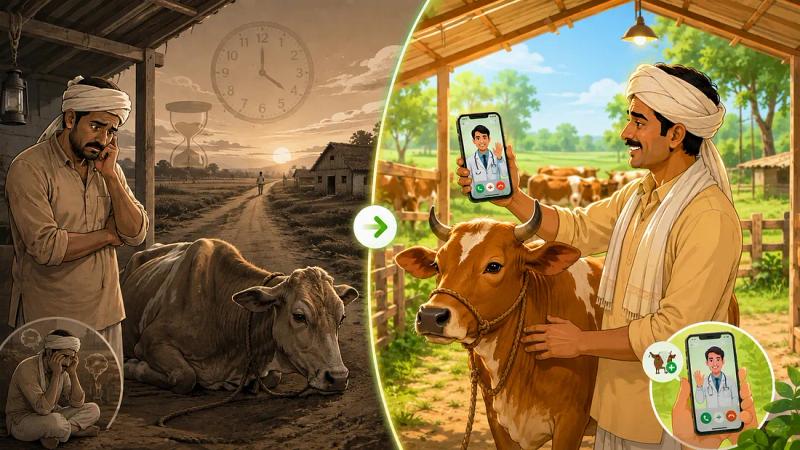
In rural India, dairy farming is not just an occupation, it is a safety net, a daily income source, a buffer against uncertainty. Yet despite its importance, cattle health is still managed the way it was decades ago: memory-based observations, rough registers, delayed veterinary visits, and “kal dekhte hain” decisions.
But cattle don’t wait.
Diseases don’t pause.
And losses don’t make noise — they simply eat into income silently.The truth is simple: India loses lakhs of rupees every year in each dairy village not because farmers lack skill, but because they lack timely information.Predictive, data-led cattle health is not a fancy idea.It is the most practical solution to one of rural India’s oldest economic problems.
1. The Silent Drain: What Disease Really Costs Rural India
One of the most researched challenges in dairy is subclinical mastitis. It shows no visible symptoms, which is why it becomes one of the biggest economic drains in villages.A major meta-analysis covering studies from 1967 to 2019 found:
• ~45% prevalence of subclinical mastitis in Indian cattle
• ~18% prevalence of clinical mastitis
Source: NIVEDI
Another peer-reviewed study estimated that mastitis causes an average loss of ₹1,390 per affected animal per lactation due to reduced yield, discarded milk, and treatment expenses.Source: https://pmc.ncbi.nlm.nih.gov/articles/PMC4100299/Across villages with small herds, this loss multiplies quickly.Now add other common issues:
• repeat breeding
• nutritional disorders
• delayed heat detection
• parasitic infections
Each appears small individually, but together they reveal an uncomfortable truth:Reactive cattle health is expensive, predictive cattle health is profitable.
2. Why Predictive Monitoring Works Better Than Human Observation
Observation-based management depends on memory, intuition, timing, and incomplete logs. This system fails not because farmers lack knowledge, but because early signs of disease are too subtle to notice.Modern livestock research consistently shows that behaviour changes before symptoms appear.
-Accelerometer and movement-based tracking can predict health issues with high accuracy.
Source: ResearchGate https://www.researchgate.net/publication/387679311_Predictive_analytics_of_cattle_behavior_using_machine_learning_techniques_A_case_study
-Early deviations in feeding, mobility, rest cycles, and rumination are strong indicators of upcoming illness.
Source: MDPI Precision Livestock Farming Reviewhttps://www.mdpi.com/2624-7402/6/2/84
- Monitoring these patterns allows early intervention, reducing cost drastically.
Source: Frontiers in Veterinary Sciencehttps://www.frontiersin.org/journals/veterinary-science/articles/10.3389/fvets.2025.1549512/full
In simple words:Cattle always “tell” us something is wrong — but data hears it earlier than humans can.
3. Where Nitara Fits In, Without Exaggeration or Unverified Claims
Nitara is not just a digital tool; it is a bridge that makes modern, predictive cattle management practical for rural India.
Nitara Farmer App
Built for digitally inexperienced farmers to:
• log cattle health events
• track symptoms
• maintain medical records
• record milk yield
• follow vaccination schedules
• get reminders for breeding cycles
This is the first essential step toward predictive care — consistent and reliable daily data.
Nitara FarmPro Web App
Designed for NGOs, cooperatives, CSR teams and large farms to:
• monitor herd-level health trends
• identify emerging disease clusters
• track nutrition, yield and reproductive performance
• assess field-team activity
• plan interventions based on evidence
Patterns become visible at scale, which is where predictive insights truly begin to matter.
Dairylytics
Dairylytics converts raw data into:
• early warning indicators
• trend analysis
• dashboards
• benchmarks
This makes predictive health a daily operational tool instead of an abstract concept.
Most importantly, Nitara does not require farmers to be “tech-savvy”.
It only needs consistency.
The system handles the rest.
4. The Village-Level Math: How Lakhs Are Lost or Saved
Imagine a small Indian dairy village with:
• 250 cattle
• 40 to 50 households
Using only verified Indian prevalence and loss data:
If ~45% develop subclinical mastitis:
≈ 112 animals affected
Loss per animal: ₹1,390
Total loss: 112 × 1,390 = ₹1,55,680
Just from one disease, in one year, in one small village.
Now consider:
• treatment costs
• discarded antibiotic-tainted milk
• repeat breeding cycles
• nutritional deficiencies
• time and labour loss
A village can lose ₹3–5 lakhs annually from avoidable health issues alone.
Even a modest 25–30% reduction in disease burden through predictive management can save ₹1–2 lakhs per year.
This is not speculation —
it is arithmetic based on India’s livestock epidemiology.
5. Beyond Savings: What Farmers Actually Feel
There is an emotional layer to this that numbers cannot quantify.
A farmer may not always voice financial stress, but it is real:
- uncertainty
- sudden vet expenses
- fear of losing a productive animal
- unexplained drop in milk yield
- helplessness when they cannot identify the cause
Predictive health brings clarity.
Instead of
“Pata hi nahi chala kab problem badh gayi”,
they begin saying,
“Data ne pehle bata diya.”
Data doesn’t replace their wisdom.
It strengthens it.
6. The Way Forward
India already has the science.
India already has the data.
India already has the need.
What was missing was a way to bring predictive livestock health to:
- Small herds
- Low-tech environments
- Busy farmers
- Scattered villages
Nitara’s ecosystem of the Farmer App, FarmPro and Dairylytics is one of the few frameworks attempting to close this gap sustainably — not by adding complexity, but by simplifying the future.
We don’t need every farmer to become a data analyst.
We just need data to reach them in a way they can use.
Because when cattle stay healthier, villages stay wealthier.
And that is how predictive, data-led cattle health saves not just money, but confidence, clarity and control.